HIGH-ATLAS MGOUN
6-day Mgoun trek to the summit of Jebel M'Goun (4071 m).
Trek description
This route is also known as the M’Goun trek or the Mgoun summit trek, passing through the beautiful Ait Bougmez valley, one of the best trekking areas in Morocco.
A beautiful ascent and a perfect approach over 6 days in this magnificent region of the High Atlas. The richness of landscapes in the M’goun massif makes it a privileged place loved by hikers.
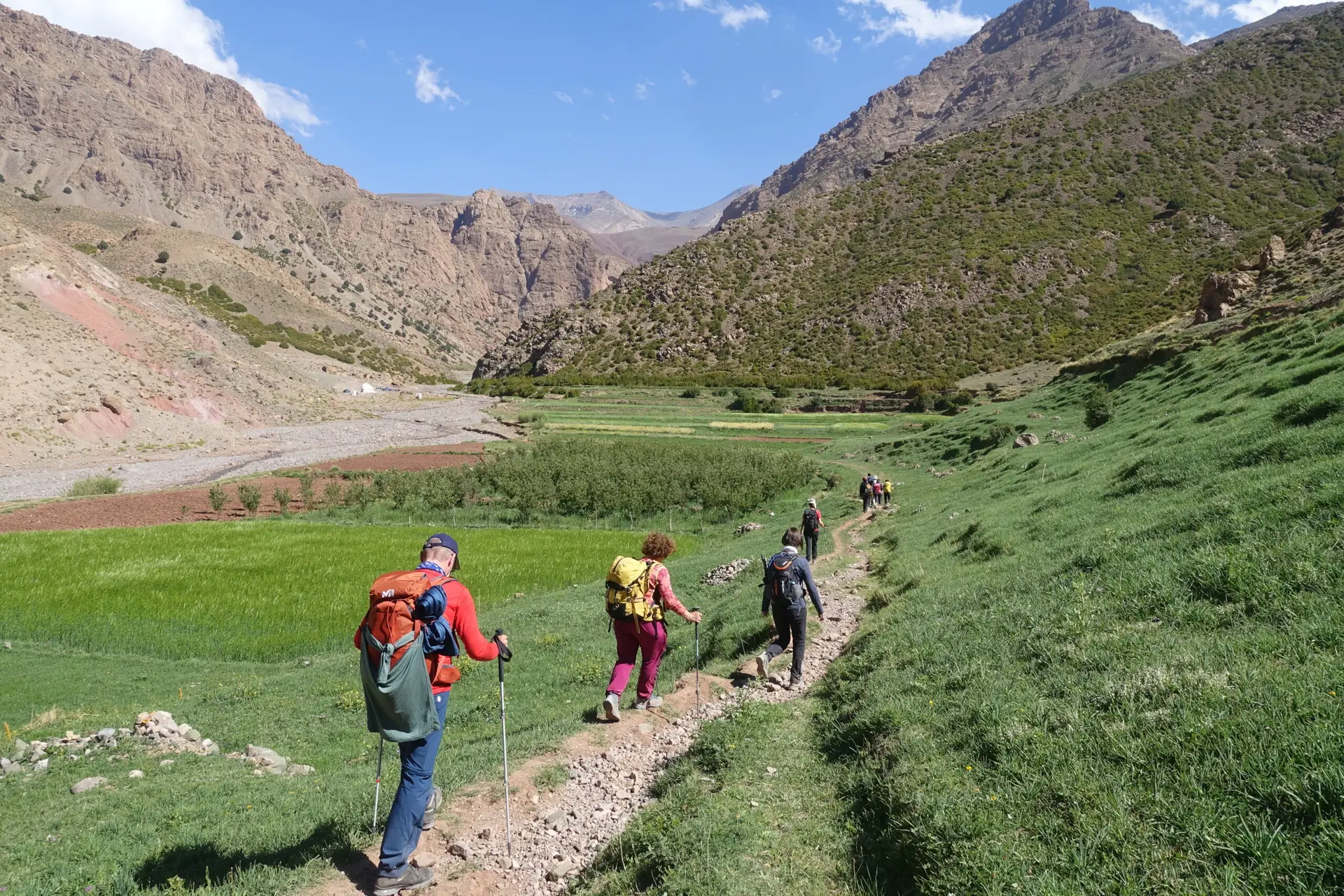
This is a 4-days trek starting from the Aït Bougmez Valley (the Happy Valley), passing through the Azib N’Ikkis sheepfolds before reaching the Tarkeddit plateau at the foot of the M’goun massif, where we encounter nomads coming from valleys in the High Atlas with their herds (goats, sheep, camels). The ascent of Mount M’goun opens up new horizons towards the entire Atlas range, and to the south, towards the Dadès Valley, the Sargho mountain range, and the Saharan expanses.
Itinerary
Day 1: Arrival in Marakech and Transfer to Ait Bougmaz
Arrivee to the aeroport in marakech and transfert to our gite in Ait bougmaz
Day 2: Talsnant -Ikkiss n'Arousse
Talsnant(1800) -Ikkiss n’Arousse(2800)
Matine : 11 km + 500m / 4h
Apres midi: 6km / 2h
Bivouac / gite tupile
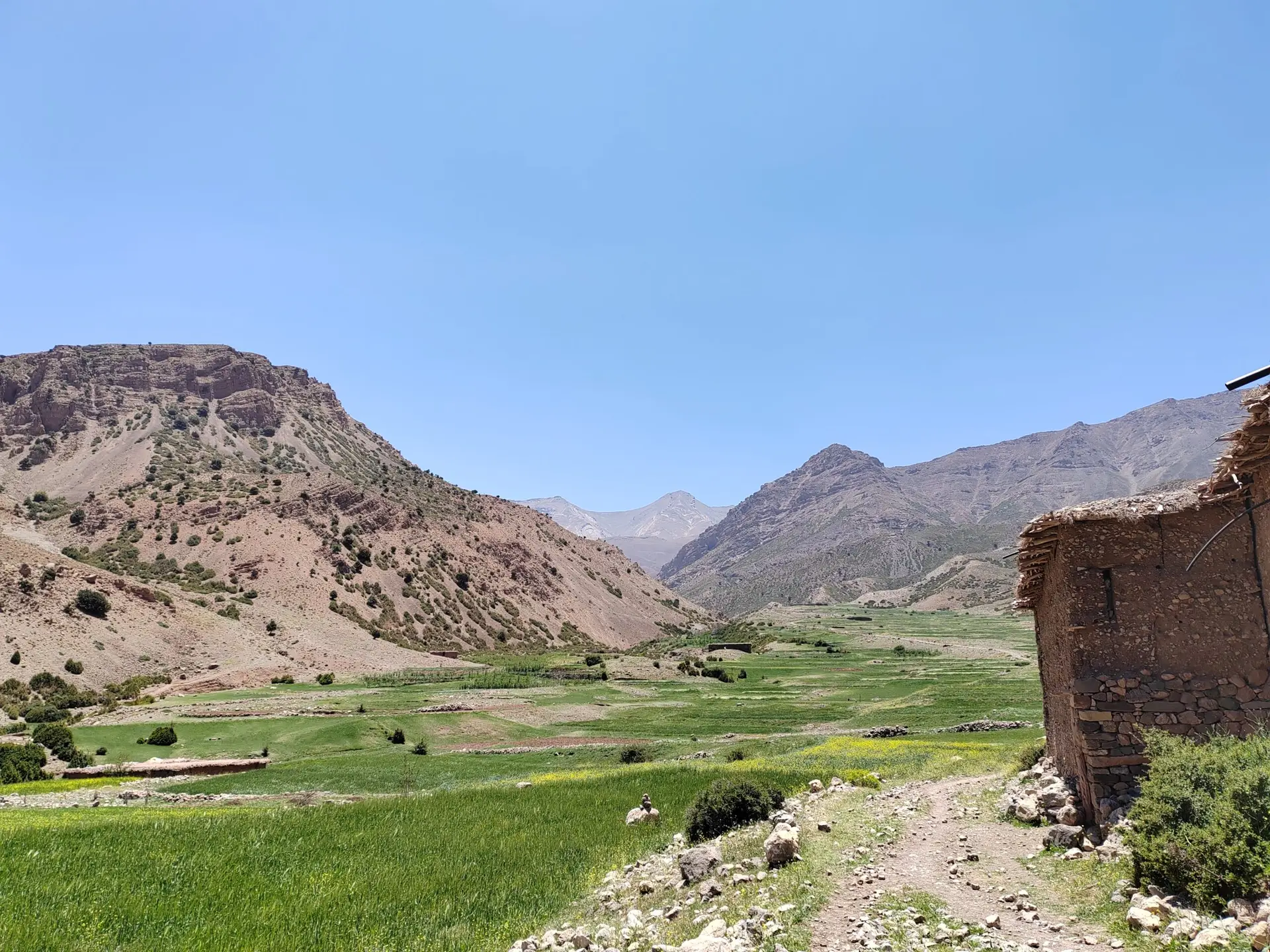
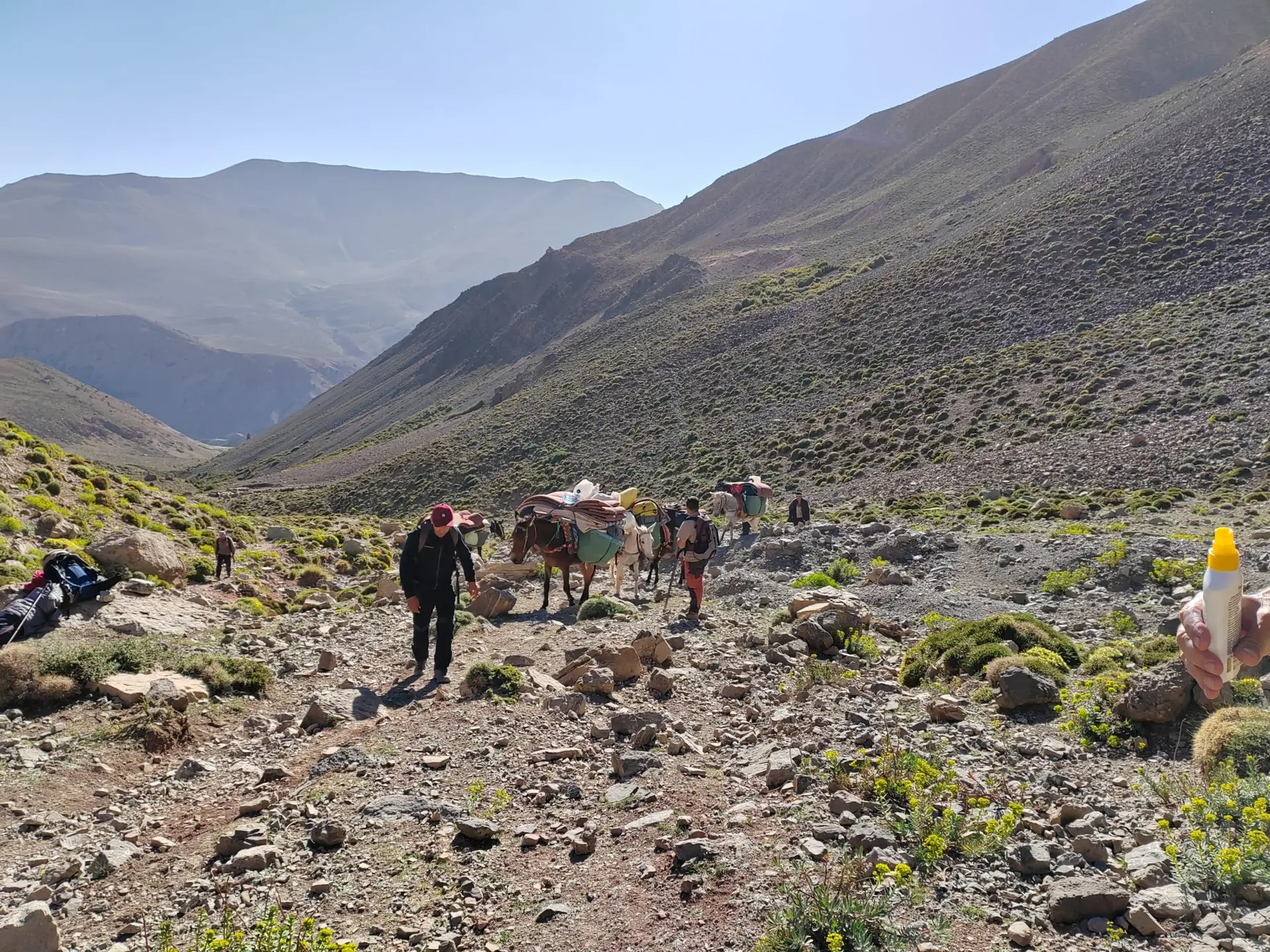
In Agouti, we meet with our mule team. Our trek to M’goun starts with crossing the beautiful Berber villages of the Arous valley with typical adobe architecture. Night under tents near the Arous sheepfolds at 2500 m. 6 hours of walking.

Day 3: Ikkiss - col Aghri- tarkddite
Ikkiss(1800) – col Aghri(3400)- tarkddite(2900)
15 km +1100 -500 / 6h15min
Bivouac / Refuge tarkddite
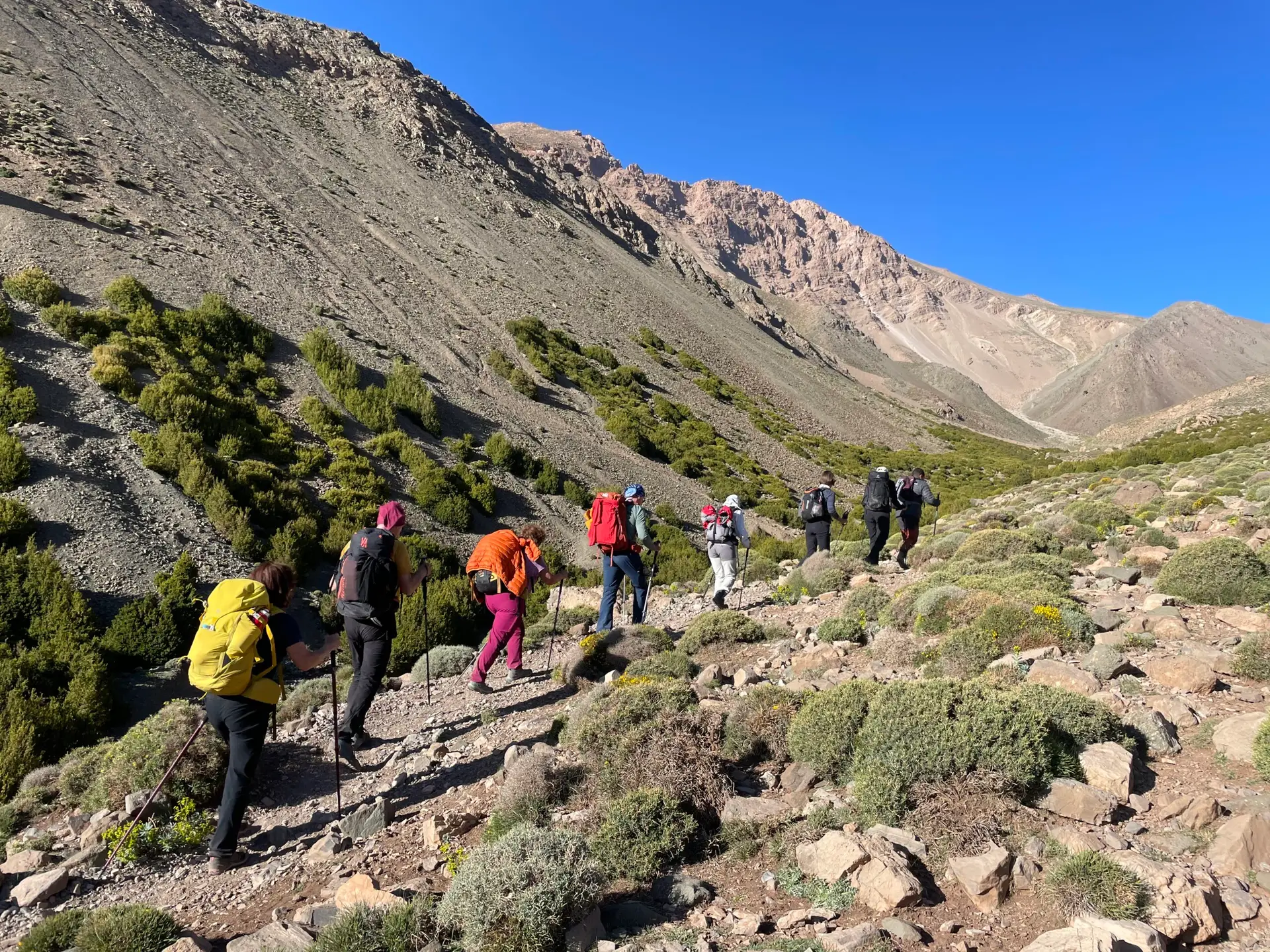
We ascend via the mule trail leading us to the Tizi n’Oughri pass (3400 m). Panoramic view of the vast northern slope of M’Goun, the Tarkeddit plateau, and the surrounding peaks. Then a descent of 1 hour and 30 minutes to our campsite near the sources of the Tassaout (2900 m). Afternoon rest. Night under tents.
Duration: 5 hours and 30 minutes of walking.
Elevation gain: 1050m ascent and 500m descent.

Day 4: Tarkddite - mgoun - IQrwiyn
Tarkddite (2900) – mgoun (4071) – IQrwiyn (2800)
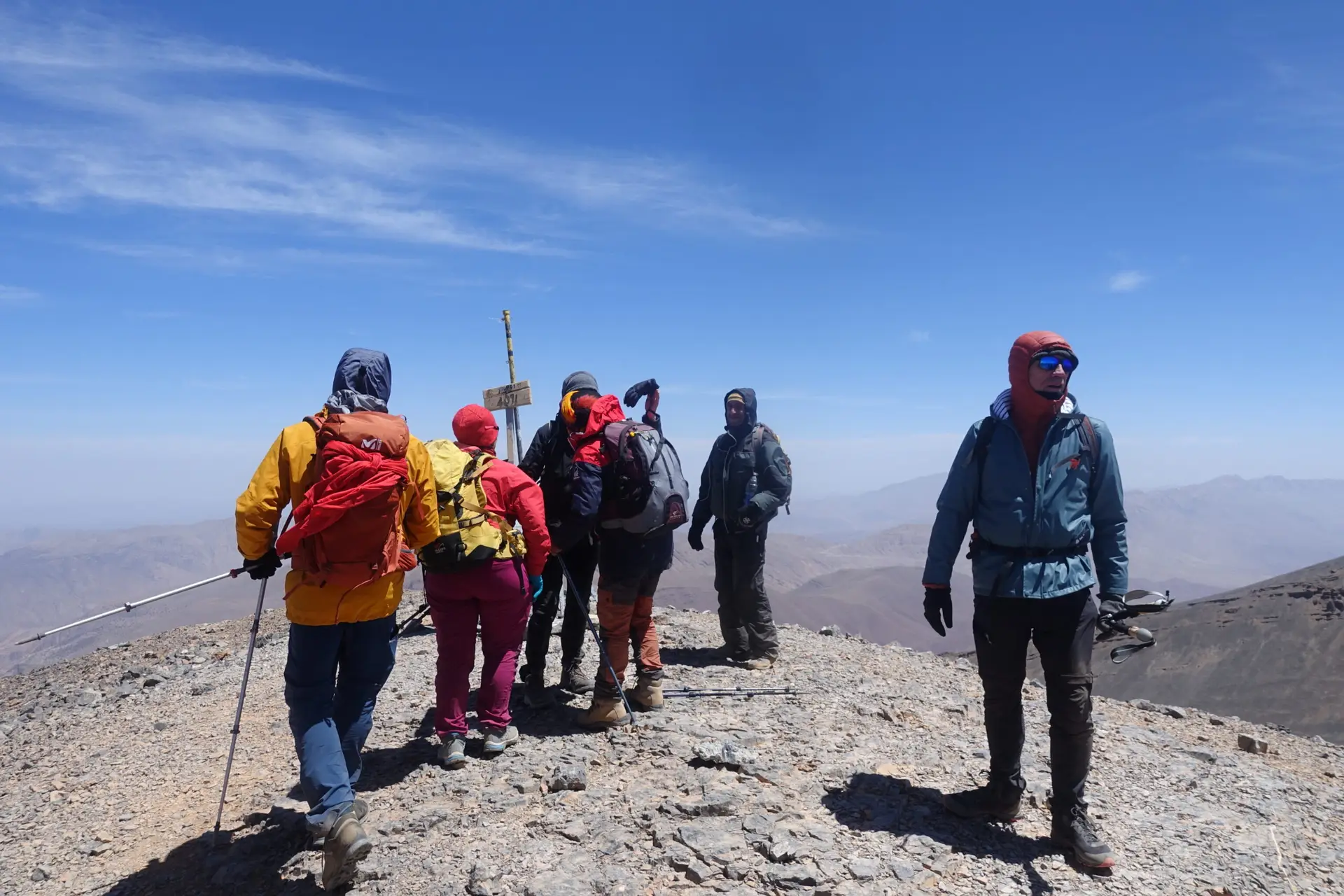
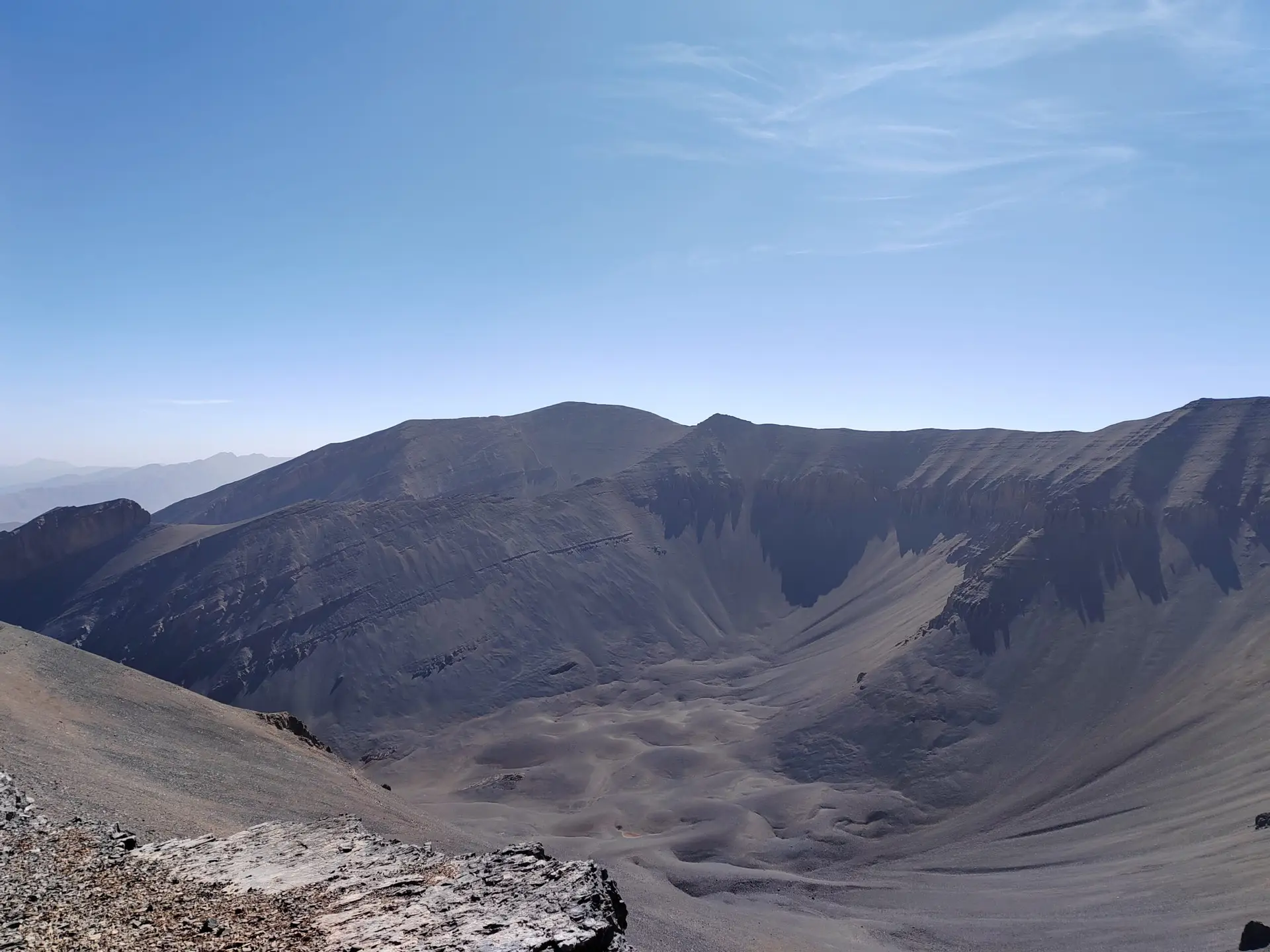
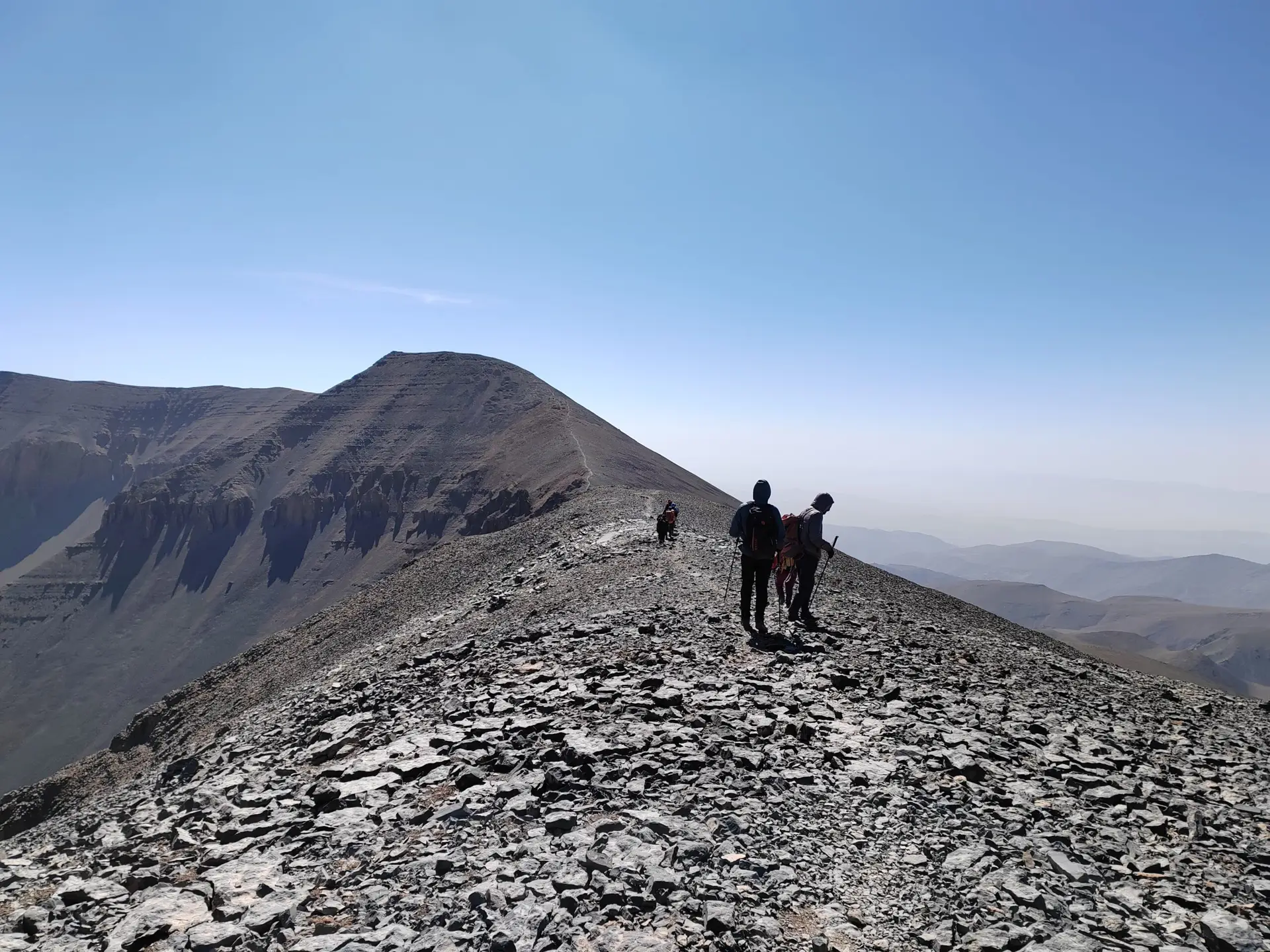
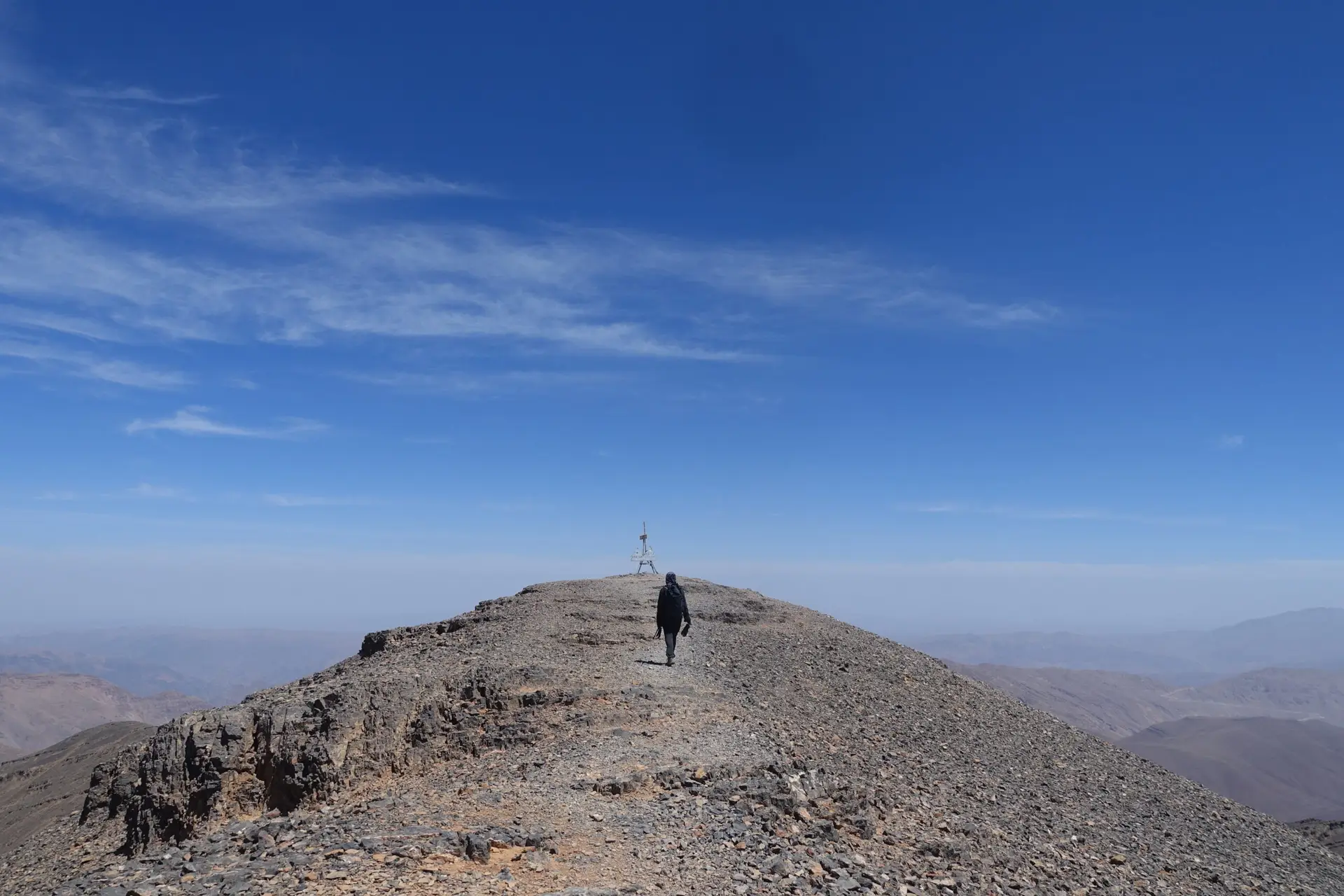
Wake up around 4 am, departure around 5 am to join the long ridge line of Ighil M’Goun, which we will follow to the summit of M’goun (4068 m). A beautiful view of the entire mountains of the Central High Atlas and, to the south, of the Dades Valley, the Sarhro Massif. After descending via the trail through a corridor, we reach the camp near the Oulilimt sheepfolds (2700 m). 9 hours of walking. 1168 m ascent and 1368 m descent. NB: For those who do not wish to ascend M’goun, it is possible to follow the path with the muleteers. Night under tents.

Day 5: IQrwiyn - Aflafel Spring - Tighrmt n ait Ahmad
IQrwiyn (2800) – Aflafel Spring (2200 m)- Tighrmt n ait Ahmad (1800)
We find ourselves in the Oulilimt valley, where the transhumants of Ait Atta temporarily settle coming from the valley of roses and the Saghro mountains to lead their nomadic life. We will descend the superb wadi, which turns into the Mgoun river. While following the course of the river, we will arrive at the Aflafel spring after 4 and a half hours of walking, we continue our hike for another hour and a half to our Gite in tighrmt n ait ahmed .

Day 6: Transfert to marakech, end of trip
After breakfast, transfer from Tighrmt n’Aït Ahmad back to Marrakech. End of our services and conclusion of your adventure in the High Atlas.

INCLUDED
- All meals during the trek (breakfast, lunch, and dinner)
- Accommodation with local families/camps
- Private ground transfers from and to Marakech
- Daily luggage transport by mules
- Certified local mountain guide
- Cultural experiences and visits to villages along the route
- Basic first aid assistance
- Group coordination and assistance throughout the trip
- Pre-departure guidance and WhatsApp group setup
NOT INCLUDED
- Flights to and from Morocco
- Travel insurance (must be arranged individually)
- Tips for guides, drivers, and local staff
- Personal expenses (snacks, souvenirs, etc.)
- Meals or drinks not specified in included
- Extra accommodation or transfers not listed
- Optional activities outside the planned itinerary
TRIP PRICE:
The price per person depends on the number of participants:
- 1 person: €1000
- 2 to 4 people: €600
- 4 to 6 people: €500
- More than 6 people: €400
SUPPLEMENTS:
- Extra night in Marakech (hotel accommodation): €50 pp*
- Private transfer to Marakech airport: €20 pp*
*Final supplement prices may vary slightly depending on hotel availability and transfer logistics.
ESTIMATED EXPENSES AT DESTINATION: €150 – €250
The estimated expenses at destination refer to meals and drinks not specified in the “what’s included” section. They do not include pre-trip expenses or personal costs at the destination such as: tips, coffee, alcoholic beverages, unscheduled activities, special requests, souvenirs, etc.
PAYMENT TERMS:
The payment for the trip is divided into three parts:
Deposit to reserve your spot: 30% of the total trip price
This first payment secures your trip dates. It is made via bank transfer.Second payment:
An additional 40% of the total price must be paid no later than 30 calendar days before the trip start date, via bank transfer.Final payment:
The remaining 30% is paid in cash on the first day of the trip to the trip coordinator.
If you confirm your participation within 30 days of the trip start date, the first and second payments (70% total) must be made together in a single bank transfer.
GROUP SIZE
There is no minimum or maximum number of participants.
The trip is confirmed regardless of group size, and the experience is adapted accordingly.
ACCOMMODATION
Accommodation is arranged with in mobile camps.
There are no hotel stays included. This provides a unique opportunity to connect with the nature and daily life of the region.
TRANSPORTATION
- Private transfer from and to Marakech is included at the beginning and end of the trip.
- During the trek, luggage is transported by mules each day, allowing participants to walk with only a daypack. in order that a minimize of lugage is neccessary.
- To travel to Morocco, you will only need a passport valid for at least 6 months from the date of entry into the country.
- Citizens of countries such as the United States, Canada, the United Kingdom, most European Union countries (including Spain,Germany, France, Italy, the Netherlands, Belgium), Australia, New Zealand, Japan, South Korea, Brazil, Mexico, and Russia generally do not require a visa for stays of up to 90 days. However, visa policies may change, so it is recommended to consult the official Moroccan consulate or embassy, or your country’s foreign affairs office for the latest information.
- If you are from another country, please check with your local consulate or embassy or at this website regarding visa requirements
| POPULATION | 37.8 million inhabitants |
|---|---|
|
ETHNIC GROUPS
|
Morocco is considered an Arab and Amazigh country. Approximately 40% of the population identifies as Arab (Arabized Amazigh), and 44% as Amazigh. The rest are Arabs.
|
|
RELIGION
|
The majority religion is Sunni Islam, practiced by 92% of the population.
|
|
LANGUAGE
|
Official languages: Classical Arabic and Amazigh. Although Classical Arabic is the official language, Moroccan people use Dariya (or Moroccan Arabic), a mix of Classical Arabic, Amazigh, Andalusian Arabic, and French.
|
|
CURRENCY
|
The official currency of Morocco is the Moroccan dirham (درهم, MAD). In Moroccan cities, there is no problem exchanging euros for dirhams. There are many banks and ATMs available for credit or debit card withdrawals.
|
|
PLUGS
|
Voltage: 220 V
Frequency: 50 Hz Plug types: C and E |
Equipment List for the Trek
- Trekking boots or sturdy hiking shoes — suitable for rough and rocky terrain
- Layered clothing — including warm layers for cold mornings/evenings and lighter clothes for hot days
- Sun protection — high SPF sunscreen, sunglasses, wide-brimmed hat or cap
- Small daypack — to carry water, snacks, and personal items during hikes
- Reusable water bottle — to stay hydrated throughout the trek
- Light rain jacket or windbreaker — for unpredictable mountain weather
- Sleeping bag — rated for moderate temperatures, ideally 3-4 season for desert nights
- Flashlight or headlamp — for use in camps and night activities
- Personal hygiene items — biodegradable soap, wet wipes, hand sanitizer
- Highly recomended: walking poles — for extra support on steep or uneven paths
Travel Insurance
Travel insurance is not included in the trip and cannot be provided by us.
We strongly recommend that all participants take out personal travel insurance that covers medical assistance, cancellations, baggage loss, and any unexpected incidents.
Please ensure your policy is valid for Morocco and covers the full duration of your journey.
- It is important to be respectful towards the local people, their customs, and their ways.
- Maintain a respectful attitude towards the group, the staff, the local population, and the country as a whole.
- Understand that some people may think or act differently from you and have different perspectives.
- Tipping is a common cultural practice in Morocco and is seen as a sign of appreciation and client satisfaction, though it is always voluntary.
- Adopt a flexible and adaptable attitude according to the circumstances at any time.
- Unexpected situations can arise despite careful planning and organization by Forestours.
- Be prepared to be flexible and show an adaptive mindset.
- If you are prone to motion sickness on road trips, bring appropriate medication.
- Forestours is responsible only for ground services at the destination.
- FORESTOURS is not responsible for flights, visas, vaccinations, or related matters.
- Recommendations and assistance will be provided based on experience.
Mgoun trek in photos